
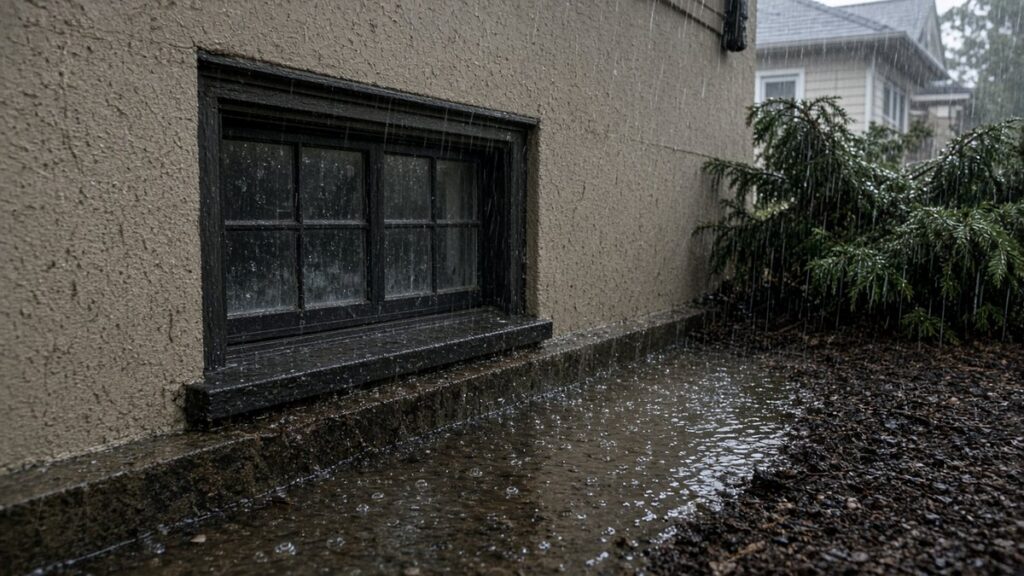
Here’s what Minnesota homeowners should know about water in basement after rain. You come downstairs the morning after a storm and find a dark line along the wall, a puddle by the floor drain, or a damp spot under the stairs. Water in your basement after rain is one of the most common concerns Minnesota homeowners raise, and the good news is that it usually follows a pattern you can learn to read.
This guide explains where rainwater typically gets in, what you can check yourself, and when it makes sense to talk with a basement waterproofing professional. At Secure Basement Solutions, we believe in education first: the more you understand about your basement, the better your decisions will be. Questions about water in basement after rain come up often in Minnesota and nearby towns.
Table of Contents
Why Minnesota basements take on water after rain
Rain doesn’t have to flood your yard to reach your basement. Most rain-related water entry comes down to three things: where the water lands, how fast the soil can absorb it, and what path it finds to your foundation. That context matters when you look at water in basement after rain in your own basement.
Surface water that drains toward the house
Roofs collect a lot of water. If gutters overflow or downspouts empty right next to the foundation, that water soaks into the backfill soil around your basement walls. Over the years, soil next to a house often settles, so a yard that once sloped away can end up sloping toward the foundation. University of Minnesota Extension recommends evaluating gutters, downspouts and surface grading first, because correcting them can solve some basement moisture problems on its own. None of this replaces an on-site look at water in basement after rain, but it gives you a head start.
Saturated soil and hydrostatic pressure
After a long or heavy rain, the soil around your foundation can become saturated. Water then presses against walls and the underside of the floor, a force called hydrostatic pressure. It pushes water through the weakest points: cracks, pipe penetrations, and the seam where the wall meets the floor. Many Minnesota neighborhoods have clay-heavy soils that drain slowly, which keeps that pressure on longer after a storm. A little background on water in basement after rain makes the rest of this guide easier to follow.
Openings in the foundation
Common entry points include:
- The floor-wall joint (cove joint): where the poured floor meets the wall. It’s a natural seam and a very common place to see water after rain.
- Wall cracks: even a hairline crack can carry water when the soil outside is saturated.
- Window wells: a well without good drainage can fill like a bucket and leak around the basement window.
- Pipe and utility penetrations: gaps around water, sewer or electrical lines.
- Block wall cores: in concrete block foundations, which are common in older Minnesota homes, water can collect inside the hollow blocks and seep out low on the wall.
Is it rain, snowmelt, or condensation?
Not every wet basement is a leak. Before choosing a fix, figure out when the moisture appears:
| When you see it | What it often points to |
|---|---|
| Within hours of heavy rain | Surface drainage, downspouts, window wells or cracks |
| A day or more after a long rain, or during spring melt | Saturated soil and hydrostatic pressure, often at the floor-wall joint |
| On hot, humid summer days with no rain | Condensation on cool walls, pipes or floors |
| All the time, regardless of weather | Plumbing leak, high groundwater or ongoing seepage |
A simple test for condensation is to tape a square of aluminum foil to the damp wall for 24–48 hours. Moisture on the room side of the foil suggests humid air condensing. Moisture behind the foil suggests water is coming through the wall. Understanding water in basement after rain helps you ask better questions before any work begins.
For snowmelt-specific issues, see our guide: Wet Basement After Rain or Snowmelt? A Minnesota Homeowner’s Starting Guide. Keeping simple records makes it easier to stay on top of water in basement after rain.
What you can check after the next rain
Safety first. If there is standing water near outlets, appliances or the furnace, stay out and call a professional. If it’s safe, here is a short checklist:
- Walk the outside of the house during or right after rain. Watch where downspouts discharge and where water pools.
- Check downspout extensions. Water should leave the downspout well away from the foundation.
- Look at grading. Soil should slope away from the house, not toward it.
- Inspect window wells. Clear out leaves and debris, and note whether water is standing in the well.
- Mark and photograph wet areas inside. Take a wide photo and close-ups, and note the date and how long after the rain it appeared.
- Listen to your sump pump (if you have one). Note whether it runs, how often, and whether the discharge outlet outside is clear.
These notes are the most useful thing you can bring to a consultation. They help separate a drainage problem from a foundation problem. Minnesota’s climate is a big part of why water in basement after rain matters here.
When small fixes aren’t enough
Fixing gutters and grading is a smart first step, but it won’t solve every case. Consider a professional assessment if:
- Water comes in at the floor-wall joint after most significant rains
- Water returns after you’ve corrected downspouts and grading
- You see new or widening wall cracks, or a wall that looks bowed
- You plan to finish the basement and need it reliably dry first
- Your sump pump runs constantly during storms, or you don’t have one
Common basement waterproofing approaches
Depending on where water is coming from, a plan may combine several of these:
- Exterior drainage corrections: downspouts, grading and surface water management
- Interior drainage (drain tile): a perforated pipe system below the floor at the perimeter that collects water and carries it to a sump basin. Learn more in our guide to interior drain tile in Minnesota.
- Sump pump system: removes collected water and discharges it away from the house. See Sump Pump Service.
- Wall crack repair: sealing specific leaking cracks. See Wall Crack Repair.
- Wall moisture management: controlling seepage and dampness on the wall surface
The right combination depends on your home. That’s why an on-site assessment matters more than any one-size-fits-all product. The sections below break water in basement after rain into plain, practical steps.
How Secure Basement Solutions helps
Secure Basement Solutions is a veteran-owned, locally owned company based in Mora, Minnesota, with more than 30 years of trade experience. We serve homeowners from Kanabec and Pine counties down through the Twin Cities metro, including Minneapolis, St. Paul, and communities across Anoka County and Hennepin County.
Our process is simple and no-pressure:
- Tell us what you see. Share your city, photos and when the water appears.
- Review the options. We explain the likely source and the recommended scope.
- Plan the project. You decide at your own pace.
Learn more about our basement waterproofing services. Every home is a little different, so water in basement after rain is best judged on site.
Water in basement after rain: frequently asked questions
Is a little water in the basement after heavy rain normal?
It’s common, but it isn’t something to ignore. Repeated water entry can damage stored items, finishes and flooring, and it raises humidity, which can lead to musty odors and mold. Track when it happens and how much. It also helps to know how water in basement after rain connects to your sump pump and drainage.
Will a dehumidifier fix water in my basement after rain?
A dehumidifier lowers humidity in the air, which helps with condensation and dampness. It won’t stop liquid water coming through a crack or the floor-wall joint. If water is entering, address the source. Clear answers about water in basement after rain make it easier to compare options.
Can I waterproof my basement walls with paint or sealer?
Surface sealers can reduce minor dampness on some walls, but they generally don’t hold back water under hydrostatic pressure. If water is pushing in at the floor-wall joint or through cracks, a drainage-based approach is usually more reliable. With that in mind, water in basement after rain becomes much easier to plan around.
Do I need a sump pump?
Not every home has one or needs one, but homes with interior drain tile need a sump system to remove the water it collects. If your basement gets wet after rain and you don’t have a sump, it’s worth discussing during an assessment. Your home’s soil, grading and drainage all play a part in water in basement after rain.
How quickly can someone look at my basement?
Send us your details through our estimate request form. A solution expert will reach out within 48 hours or by the next business day.
Have water in your basement after rain?
Tell us what you’re noticing, when it happens and where you live in Minnesota. We’ll help you understand what’s going on and take the next step toward a drier basement.
Request an Estimate or call 320-280-3522.