
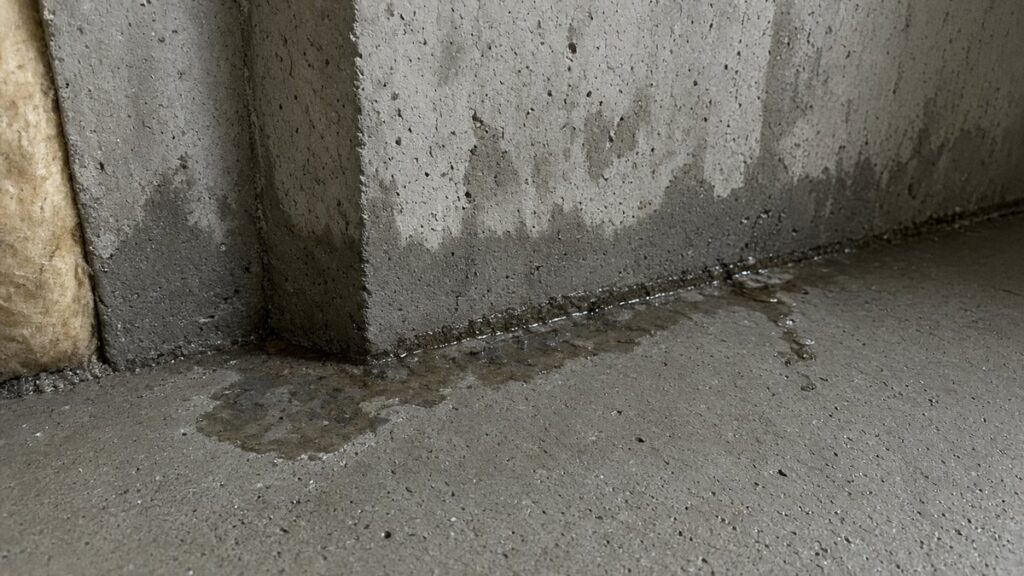
A thin dark line where your basement wall meets the floor is one of the most common signs of wet basements MN homeowners see, especially after a soaking fall rain or the spring thaw. That seam has a name: the cove joint. Here in Mora and across Kanabec County, it’s often the first place water shows up. This guide explains why a floor wall joint leak starts at the cove joint, how to tell it apart from other problems, and what basement waterproofing MN options actually stop it.
Table of Contents
What is the cove joint?
Most Minnesota basements are built in steps:
- The footing is poured first.
- The walls go on top of the footing.
- The floor slab is poured last, inside the walls.
Because these pieces are poured at different times, they never fully bond. The seam between wall and floor is a built-in gap. It’s normal, but it’s also a natural path for water. For many Mora homes, a floor wall joint leak is worth reviewing every spring and fall.
Why water comes in at the floor-wall joint
Hydrostatic pressure
When the soil around your home fills with water, that water pushes against the walls and up under the slab. This is called hydrostatic pressure. Water takes the easiest route in, and the cove joint is usually the easiest. Every home is a little different, so a floor wall joint leak is best judged on site.
Clay and slow-draining soil
Soils around east-central Minnesota range from sandy to heavy clay. Clay holds water and drains slowly, so pressure stays high for days after a storm.
Missing or clogged drainage
Many homes have no drain tile at all. Older systems can clog with silt or roots over time. When there’s nowhere for water to go, it collects at the footing and rises to the joint. Minnesota’s climate is a big part of why a floor wall joint leak matters here.
Snowmelt and spring thaw
In Mora, deep snowpack melts fast in March and April. The ground may still be frozen a few inches down, so meltwater runs along the frozen layer straight toward your foundation.
Cove joint leak or something else?
Before choosing a fix, rule out lookalikes:
| What you see | Likely cause |
|---|---|
| Even line of water along the joint after rain | Hydrostatic pressure at the cove joint |
| Water trickling from one spot up the wall | A wall crack or pipe gap |
| Wet floor in the middle of the room | Slab crack, floor drain backup or high water table |
| Damp walls on humid summer days, no rain | Condensation |
Quick test: Tape a square of aluminum foil to the damp floor near the wall for 24–48 hours. Moisture under the foil points to water coming through. Moisture on top points to condensation. If you’re unsure about a floor wall joint leak, an on-site assessment can answer the question.
Seeing water at the joint right now? We’re available 24/7. Call 320-280-3522 or Request an Estimate.
What doesn’t fix a cove joint leak
Homeowners often try these first. They rarely last:
- Caulking the joint. Water pressure pushes it loose, or water simply finds the next weak spot.
- Waterproof paint. It can peel off under pressure and hides the problem.
- A dehumidifier alone. It dries the air but can’t stop liquid water.
These can buy time, but they don’t relieve the pressure behind the wall. Your home’s soil, grading and drainage all play a part in a floor wall joint leak.
Basement waterproofing options that work
The goal is to relieve the pressure and give water a planned path out.
Interior drain tile and sump pump
A perforated pipe is set in a trench along the inside of the footing, below the slab. It collects water before it reaches the joint and carries it to a sump basin. A sump pump then sends it outside, away from the house.
Wall drainage membrane
A dimple membrane on the lower wall directs any wall seepage down into the drain tile, so it never crosses the floor. Keeping simple records makes it easier to stay on top of a floor wall joint leak.
Exterior corrections
Extending downspouts and fixing grading reduce how much water reaches the foundation in the first place. They’re a smart first step, though not always enough by themselves. Older and newer homes alike can benefit from a closer look at a floor wall joint leak.
Foundation repair when needed
If the joint leak comes with cracked, shifting or bowing walls, the structure needs attention too. That’s where foundation repair MN work comes in, alongside waterproofing.
Simple steps to take this week
- Photograph the joint after the next rain and note how long after it started.
- Check downspouts. Extend them so water lands well away from the house.
- Look at the grade. Soil should slope away from the foundation.
- Clear window wells of leaves and debris.
- Move stored items off the floor near the wall.
University of Minnesota Extension has a helpful overview of moisture in basements: causes and solutions. It also helps to know how a floor wall joint leak connects to your sump pump and drainage.
Local help in Mora and Kanabec County
Secure Basement Solutions is veteran-owned, locally owned and based in Mora. We bring more than 30 years of trade experience to homes across Mora and Kanabec County, plus nearby towns and the Twin Cities metro.
No pressure, education first. We’ll look at where the water comes from and explain your options before you decide anything. Learn more about our basement waterproofing service.
Warning signs to watch for
- Water stains on stored boxes, carpet or drywall
- White, chalky residue (efflorescence) on concrete or block
- Damp spots or dark lines on walls or along the floor-wall joint
- Musty smells that linger even when the basement looks dry
- Anything that has changed in your Mora home since last season
- Rust on metal shelving, appliance legs or furnace bases
- Peeling paint or bubbling coatings on walls
Your fall basement checklist
- Service the sump pump and protect the discharge line.
- Add window well covers before snow.
- Seal leaking cracks before winter.
- Clean gutters after the leaves drop.
- Fix grading before the ground freezes.
Questions to ask before you hire anyone
Questions worth asking any contractor:
- What’s included in the estimate?
- Is there anything I can do myself first?
- What’s causing the issue?
- Have you worked on homes around Mora?
- What are my options, and what are the trade-offs?
- Is a warranty offered, and what does it cover?
You can also check contractor licensing through the Minnesota Department of Labor and Industry. A good contractor will answer clearly and won’t rush you. Keep that in mind if you live in or near Mora. Clear answers about a floor wall joint leak make it easier to compare options.
Floor wall joint leak: frequently asked questions
Is water at the floor-wall joint serious?
It isn’t an emergency in most cases, but it usually gets worse with each wet season. It can damage flooring, raise humidity and lead to musty odors. Questions about a floor wall joint leak come up often in Mora and nearby towns.
Can I seal the cove joint myself?
You can, but sealing usually fails because it doesn’t relieve the water pressure. A drainage-based fix is more reliable.
Does every home need a sump pump?
No. But homes with interior drain tile need a sump to remove the water it collects.
Is basement waterproofing worth it if I don’t plan to finish the basement?
Yes. Water damages stored items, raises humidity in the whole house and can encourage mold, finished or not. It’s a good rule of thumb for Mora-area houses.
Can I waterproof a basement in winter?
Interior work can commonly be done year-round. Ask about scheduling when you request an estimate. Keep that in mind as you think through a floor wall joint leak.
Get your basement dry
Water at the floor-wall joint has a clear cause and a clear fix. Tell us what you’re seeing and where you live.
Day or night, 24/7: call 320-280-3522 or Request an Estimate. We serve Mora, Kanabec County and nearby communities.